Why Environmental Testing Matters for Pakistan's Industries
22 January 2025 · AIMS TEC
New to the topic? Read Part 1: What is Environmental Testing? first.
Pakistan is one of the most environmentally stressed industrial economies in the region. Lahore regularly ranks among the most polluted cities globally. Major rivers receive millions of litres of untreated industrial effluent daily. For most facilities, environmental monitoring has historically been reactive — undertaken before an inspection, not as a structured operational practice. That is beginning to change, driven by pressures that are simultaneously regulatory and commercial.
1. It Is a Legal Requirement — and Enforcement Is Increasing
Pakistan’s environmental framework — built on the Pakistan Environmental Protection Act (PEPA) 1997 and the National Environmental Quality Standards (NEQS) — requires facilities to keep emissions, effluents, and waste within defined limits. These are legal obligations, not advisory guidelines. Violations can lead to production suspensions, financial penalties, and in serious cases, criminal liability for company management.
Historically, enforcement was inconsistent. But Provincial EPAs — particularly in Punjab and Sindh — have become considerably more active. Facilities that previously operated without structured monitoring are receiving compliance notices. Having regular, documented analytical results is the clearest mechanism to demonstrate regulatory standing. Where inspection services are part of a facility’s compliance programme, environmental performance data provides the evidence that supports and contextualises inspection findings.
2. International Buyers Are Making It a Commercial Condition
This is the most immediate pressure for Pakistani manufacturers, particularly in the textile sector. European and American brands have significantly tightened supplier environmental requirements. Verified data on wastewater discharge, chemical usage, and stack emissions is now standard in supplier audits for many major buyers.
Pakistan’s textile sector earns over $15 billion in annual exports. Suppliers unable to produce documented environmental performance data are increasingly being passed over in favour of competitors in Bangladesh, Vietnam, and India — countries that invested earlier in operational controls. This is a concrete commercial risk, not a distant regulatory concern.
Worth noting: The EU’s Corporate Sustainability Due Diligence Directive (CSDDD), which came into force in 2024, requires European companies to verify environmental performance throughout their supply chains. Pakistani exporters supplying EU-based brands will increasingly need structured monitoring data to retain those contracts.
“Environmental monitoring is no longer a regulatory obligation operating in isolation — it is increasingly a commercial prerequisite for export-oriented facilities supplying international buyers.”
— AIMS TEC Technical Team
3. Worker Health Is a Direct Operational Risk
Pakistan’s industrial workforce — in tanneries, dyeing units, brick kilns, cement plants, and chemical facilities — is routinely exposed to hazardous substances: hexavalent chromium, volatile organic compounds (VOCs), silica dust, and asbestos fibres. Many of these exposures are gradual and invisible, making them easy to overlook until chronic illness or a legal case forces attention.
Workplace air quality assessment — integrated into a broader analytical monitoring programme — identifies these hazards at measurable concentrations and allows engineering controls to be implemented before damage occurs. Beyond the ethical dimension, occupational disease claims and labour disputes carry significant financial and reputational costs. Systematic monitoring is a practical mechanism to manage that exposure proactively.
4. Communities Are Paying Closer Attention
In cities like Kasur, Faisalabad, and Gujranwala, communities located near industrial clusters have become markedly more vocal. Protests, investigative media coverage, and formal petitions to local authorities have compelled several facilities to suspend operations or fund costly remediation programmes. In some cases, the reputational consequences have been lasting.
Regular environmental monitoring — and transparency about results — does not eliminate community tensions, but it provides businesses with a credible, data-backed basis for engagement rather than categorical denial.
Facilities that have maintained documented monitoring programmes prior to a community or regulatory challenge are consistently better positioned than those attempting to construct a compliance record retrospectively. The evidential value of longitudinal data is considerably higher than point-in-time sampling.
5. ESG Is Becoming a Financing Condition
The State Bank of Pakistan’s Green Banking Guidelines encourage financial institutions to integrate environmental risk into lending decisions. Development finance institutions — the Asian Development Bank, World Bank, IFC — routinely require environmental performance data as a condition of project financing.
For businesses seeking sustainability-linked loans, green bonds, or concessional climate finance, analytical monitoring data is not optional — it is the evidence underpinning any ESG claim. Facilities that have tracked their environmental footprint over time are better positioned to access these instruments than those starting from zero. Engineering consultancy services, including GHG inventory preparation and carbon footprint assessment, are increasingly integrated with monitoring programmes for this reason.
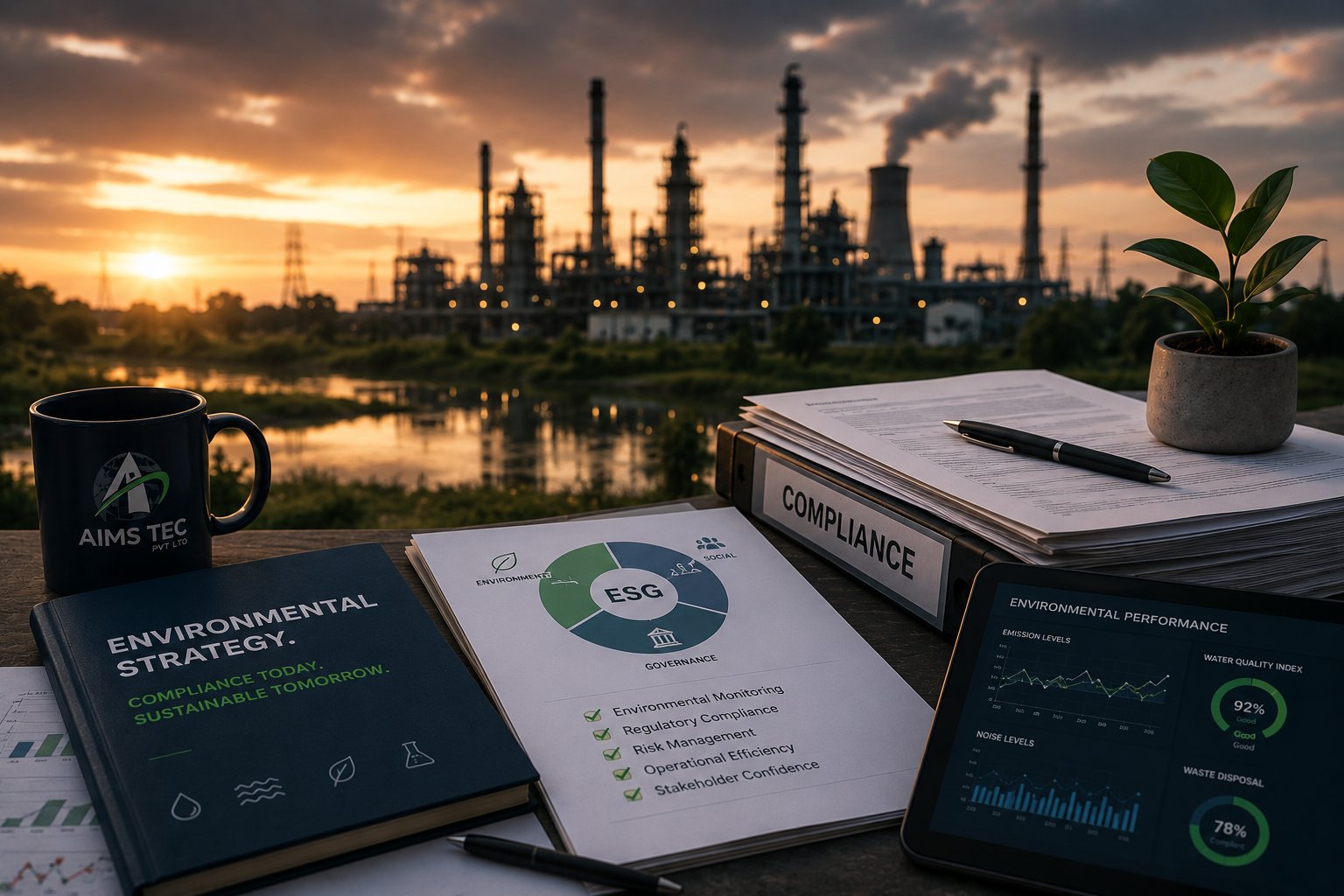
Environmental strategy, ESG documentation, and real-time performance dashboards — the three layers of a structured compliance programme. Facilities integrating monitoring data into ESG reporting are better positioned to access sustainability-linked financing instruments.
6. Monitoring Often Reveals Operational Inefficiencies
This is the benefit that most frequently surprises facility managers. Analytical monitoring is not only about identifying problems — it quantifies what is leaving a process. Effluent with elevated chemical oxygen demand often indicates raw materials going to waste rather than into the product. Stack emissions assessment on a boiler can reveal combustion inefficiencies that translate directly into unnecessary fuel expenditure. Soil analysis can indicate over-application of inputs that is not improving yield.
A well-structured monitoring programme frequently recovers its cost — sometimes many times over — through operational improvements within the first one to two years. The data identifies where resources are leaving your process unnecessarily.
Which Industries Face the Most Pressure in Pakistan?
Every industry generates some environmental impact, but the following sectors face the sharpest regulatory and commercial pressure at present:
- Textile & Dyeing — effluent, heavy metals, azo dyes
- Cement & Construction — particulate matter, stack emissions
- Pharmaceuticals — API contamination in wastewater
- Food & Agro-Processing — pesticides, mycotoxins, heavy metals
- Oil, Gas & Petrochemicals — soil and groundwater contamination
- Leather & Tanning — chromium-rich effluent
- Power Generation — SOₓ, NOₓ, ash disposal
- Mining & Quarrying — acid mine drainage, dust, heavy metals
The Regulatory Framework at a Glance
Understanding which bodies and standards apply to your facility is a practical starting point for any structured compliance programme:
| Body / Standard | What It Covers | Type |
|---|---|---|
| Pakistan Environmental Protection Act (PEPA) 1997 | National law governing all environmental matters | Law |
| National Environmental Quality Standards (NEQS) | Sector-specific emission, effluent & ambient limits | Standard |
| Pak-EPA & Provincial EPAs (SEPA) | Enforcement at national and provincial level | Regulator |
| PSQCA | Product and industrial process quality standards | Standards Body |
| ISO 14001 EMS | International framework for environmental management systems | ISO Standard |
| WHO Air & Water Guidelines | International benchmarks referenced by buyers and lenders | Guideline |
Facilities building structured compliance programmes typically integrate environmental monitoring, calibration, inspection, and documentation into a unified operational workflow. For most industries in Pakistan, the question is no longer whether monitoring is required — it is whether the programme in place is sufficiently documented, methodologically sound, and able to withstand scrutiny during regulatory review or commercial audit.
Explore our Environmental Testing services or discuss your requirements with our team.