What is Environmental Testing?
15 January 2025 · AIMS TEC
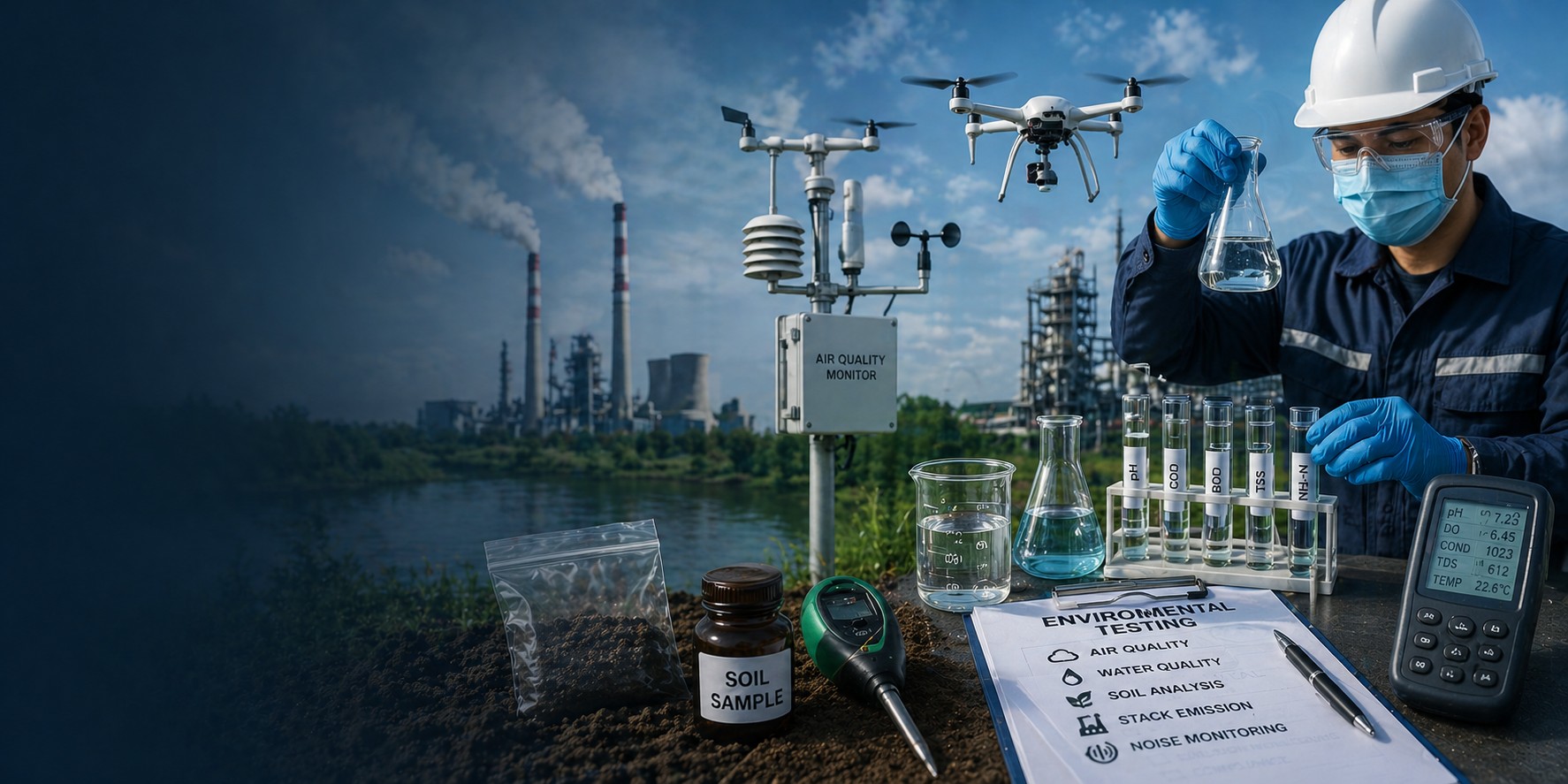
If you work in manufacturing, construction, food production, or any sector that interacts with the natural environment, you have probably encountered the term “environmental testing.” But what does it actually involve — and why is it becoming harder to ignore for industries operating in Pakistan?
The Basic Idea
Environmental testing is the process of collecting samples from the surrounding environment — air, water, soil, or biological matter — and analysing them in a laboratory to determine what is present and at what concentration. The objective is to detect pollutants or contaminants, quantify their levels, and establish whether those levels fall within acceptable safety thresholds.
The science involved is quite precise. Laboratories use techniques such as gas chromatography, atomic absorption spectroscopy, and mass spectrometry to detect pollutants at concentrations as small as parts per billion — quantities invisible to the human senses yet potentially harmful over time.
At its core, every analytical test is answering three questions:
- What is present? — Which specific chemicals, metals, bacteria, or particulates appear in the sample?
- How much of it? — At what concentration — is it a trace amount or a level that exceeds established limits?
- Is it a problem? — How does it compare against Pakistan’s NEQS standards, WHO guidelines, or buyer specifications?
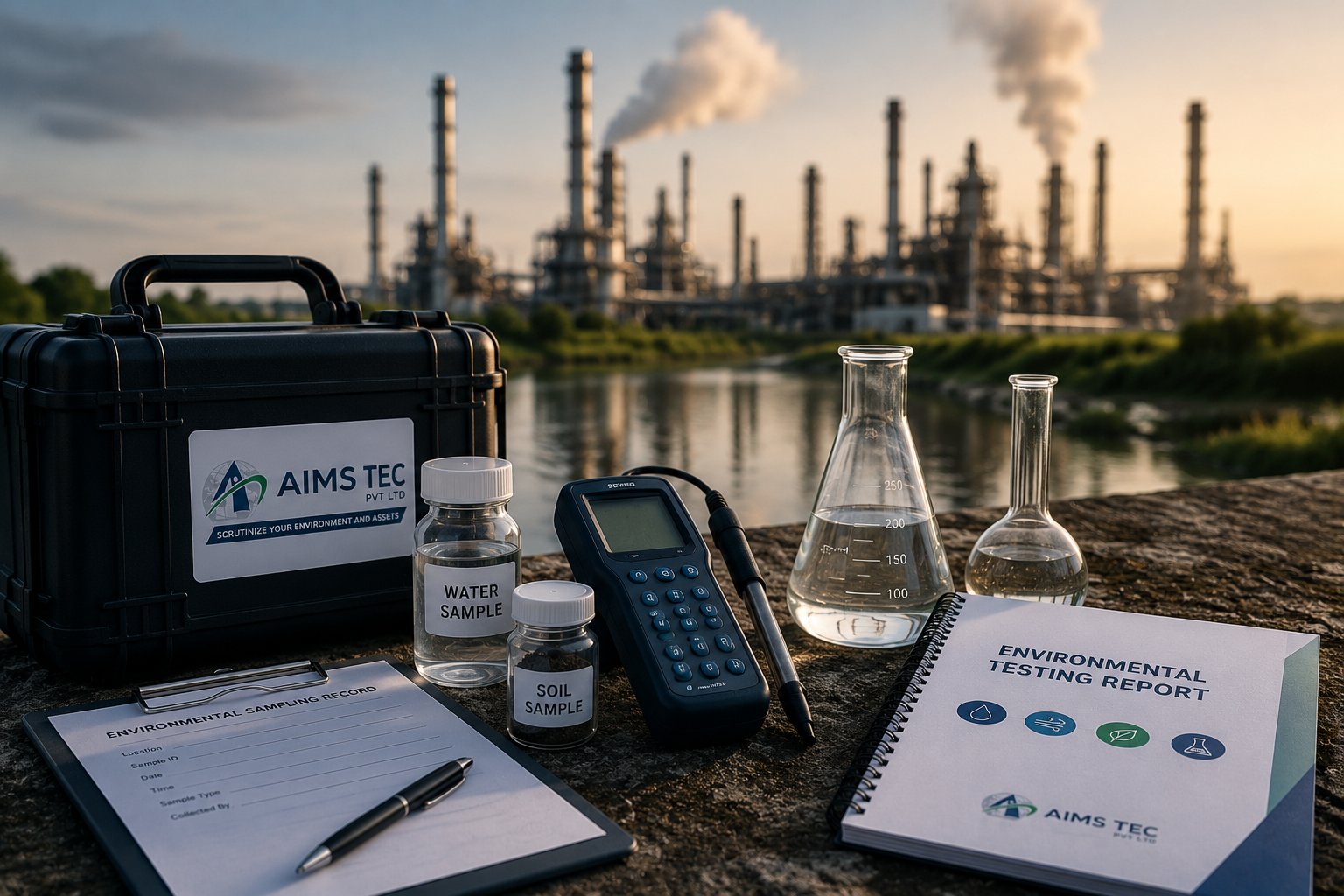
Field sampling equipment, sample containers, and documentation forms — the physical components of a structured environmental monitoring programme. Water and soil samples are collected on-site using calibrated instruments before transfer to the laboratory under chain-of-custody controls.
The Four Main Areas of Assessment
Environmental monitoring is not a single discipline — it spans four distinct technical areas, each with its own methods and regulatory framework:
- Water Quality — Testing rivers, groundwater, industrial discharge, and drinking water sources for heavy metals, pathogens, pH, BOD, COD, and chemical contaminants.
- Air & Stack Emissions — Measuring ambient air quality (PM2.5, PM10, NOₓ, SO₂) and stack emissions from industrial plant against NEQS limits and international standards.
- Soil & Sediment — Identifying heavy metal accumulation, organic pollutant profiles, and nutrient levels on industrial, agricultural, or contaminated land.
- Biological & Microbiological — Assessing microbial safety in water, food processing environments, and pharmaceutical operations — including coliform, E. coli, and HPC analysis.
Most facilities do not require all four assessment types simultaneously. A textile operation would focus on water and air assessment; a cement plant would prioritise stack emissions; a food processor would concentrate on water and microbiological parameters. The appropriate monitoring scope depends on what your facility produces, its process inputs, and applicable regulatory obligations. AIMS TEC’s Environmental Testing services page outlines the full range of analytical categories available.
How a Test Actually Works
A properly structured monitoring programme follows a documented chain — the result is only as credible as the process behind it:
- Planning — determining what to measure, where to collect samples, and which parameters are relevant based on industry type, site conditions, and regulatory obligations.
- Field collection — trained technicians gather samples using calibrated equipment, with strict documentation protocols to prevent contamination or breaks in chain of custody.
- Laboratory analysis — samples are processed using standardised methods — APHA, US EPA, ASTM, or BSI protocols — appropriate to the parameter and the intended use of the result.
- Interpretation — results are compared against Pakistan’s National Environmental Quality Standards (NEQS) or relevant WHO and international benchmarks.
- Reporting — a formal report documents findings, flags any exceedances, and provides context on what the results mean for the facility’s regulatory position.
“The documentation chain matters as much as the analytical result itself. If test data is questioned by a regulator or auditor, chain of custody is what makes the result legally defensible.”
— AIMS TEC Technical Team
This is also why instrument calibration is integral to any monitoring programme: uncalibrated equipment produces results that cannot be relied upon or successfully defended under regulatory scrutiny.
Not All Testing Is Equal
One important point for any facility commissioning analytical work: the quality of results varies significantly between providers. A result from a laboratory using uncalibrated instruments, non-standardised methods, or inadequate documentation may not hold up under regulatory review.
When evaluating an environmental testing provider, look for standardised methodologies, properly calibrated equipment, a documented chain of custody, and qualified environmental scientists conducting the work — not general-purpose technicians. In Pakistan, results submitted to EPA Sindh or to international buyers typically need to follow recognised methodologies to be accepted. Cutting corners on testing can produce a false sense of compliance, which is frequently more damaging than no programme at all.
For an overview of AIMS TEC’s approach to environmental monitoring in Pakistan, including the methodologies we follow and the types of facilities we work with, see our Environmental Testing services page.
Facilities building structured compliance programmes typically integrate environmental monitoring, calibration, inspection, and documentation into a unified operational workflow. Understanding what each analytical discipline involves is the foundation — implementing it with the appropriate scope, methodology, and traceability is where structured support makes the difference.
Continue reading: Why Environmental Testing Matters for Pakistan’s Industries, or discuss your requirements with our team.